
.svg)


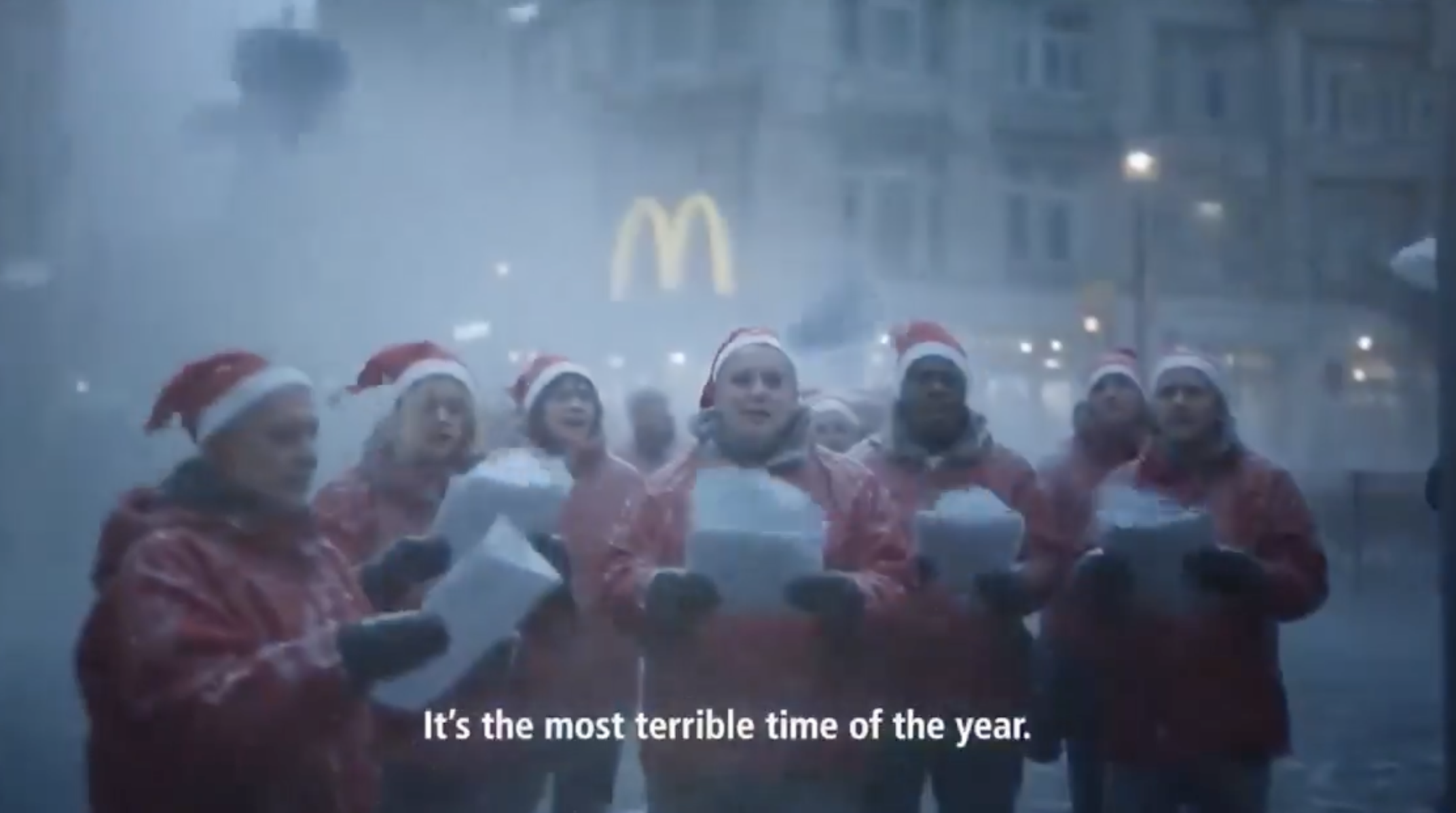
McDonald's recently unveiled a Christmas ad designed entirely using artificial intelligence.
A first for the brand.
And an immediate shock.
As soon as it was put online, the video aroused massive discomfort: negative reactions, closed comments, then outright withdrawal of the film by McDonald's Netherlands.
However, beyond instinctive rejection, this case deserves better than a simple binary verdict.
Because this ad tells something much more profound about the current limitations of AI-assisted advertising creation.
Decryption.
A disturbing first impression
At the first viewing, the reaction was almost unanimous.
The movie accumulates signs of discomfort:
- deformed faces,
- inconsistent body movements,
- artificial facial expressions,
- anxiety-provoking, almost dystopian atmosphere.
The whole thing is more like an episode of Black Mirror than a Christmas movie for the general public.
However, at this time of year, the expectation is clear: warmth, emotion, reassurance.
Here, the opposite dominates.
A creative intention that is nevertheless identifiable
By watching the ad a second time, the intention becomes more legible.
The bias seems to be taken for granted:
- represent the chaos of December,
- adopt a deliberately cheap rendering,
- play with the aesthetics ofAI-Slop,
- position McDonald's as a familiar hideaway in an absurd world.
On paper, the idea holds up.
Especially since the contrast is strong with other brands, such as Coca-Cola, which have opted for extremely slick AI ads that are faithful to their historical DNA.
McDonald's clearly looked for the opposite:
more creaky, more absurd, more disturbing.
The problem: a poorly assumed intention
Where the movie fails is not on the concept.
It's about her emotional execution.
Because once the video is published:
- comments have been deactivated,
- then the ad removed.
A strong signal.
And contradictory.
If discomfort had been fully accepted as a radical creative choice, the brand could have held its own line, provoked debate, and even transformed controversy into cultural discussion.
By removing the film, McDonald's is implicitly invalidating its own bias.
An emotional disappointment that is more than a technical one
Technical faults are visible.
But that is not the core of the problem.
The real failure lies elsewhere:
- no laughing,
- no surprise,
- no narrative twist,
- no identifiable emotion.
However, in Christmas advertising, to miss the emotion is to miss the campaign.
The discomfort could have been a lever.
It's just an extraneous noise here.
AI production far from being “fast and economical”
Another point that is rarely put forward in the discourse around this campaign.
The movie was produced by TBWA\ Neboko, with The Gardening Club, the AI division of The Sweetshop Films.
The studio communicated on:
- 7 weeks of production,
- thousands of generations,
- a team mobilized continuously.
In other words:
- no express production,
- no obvious reduction in costs,
- no radical simplification of the process.
In this specific case, AI did not save time or guarantee a better creative result.
The Uncanny Valley trap in AI advertising
This ad is a perfect illustration of a key phenomenon: The Uncanny Valley.
The more a creation tries to get closer to reality without reaching it completely, the more the discomfort is amplified.
And in advertising, the tolerance for strangeness is extremely low.
With AI:
- the slightest visual incoherence is obvious,
- each micro-error is perceived as a bug,
- the artifact becomes more visible than the intention.
Where a stylized animated film is accepted, a failed near reality is rejected.
What this bad buzz reveals about AI creation
Beyond the McDonald's case, this campaign highlights several structuring lessons.
AI is not a magic wand.
It does not automate emotion, narration, or creative accuracy.
On the contrary, it requires:
- an extremely precise artistic direction,
- a clear vision from the start,
- a rigorous control of the details,
- total coherence with the brand's DNA.
The stronger the brand, the more expensive the mistake.
AI requires you to be more demanding, not less
Contrary to popular belief, AI does not forgive anything.
It amplifies faults.
In advertising:
- emotional incoherence becomes discomfort,
- creative ambiguity becomes rejection,
- A bad read becomes a global bad buzz.
This case recalls a simple truth:
using AI in advertising creation often requires more precision, no less.
Conclusion
McDonald's AI advertising is not a failure because it uses AI.
It fails because the emotion has not been fully controlled.
This bad buzz shows that:
- AI does not replace creative intent,
- it does not guarantee efficiency or savings,
- it exposes brands to increased reputational risk.
The future of AI-enabled advertising is likely to be faster, more flexible, and more technological.
But it will remain subject to the same fundamental rule:
without just emotion, there is no successful campaign.

.png)


.webp)
