
.svg)


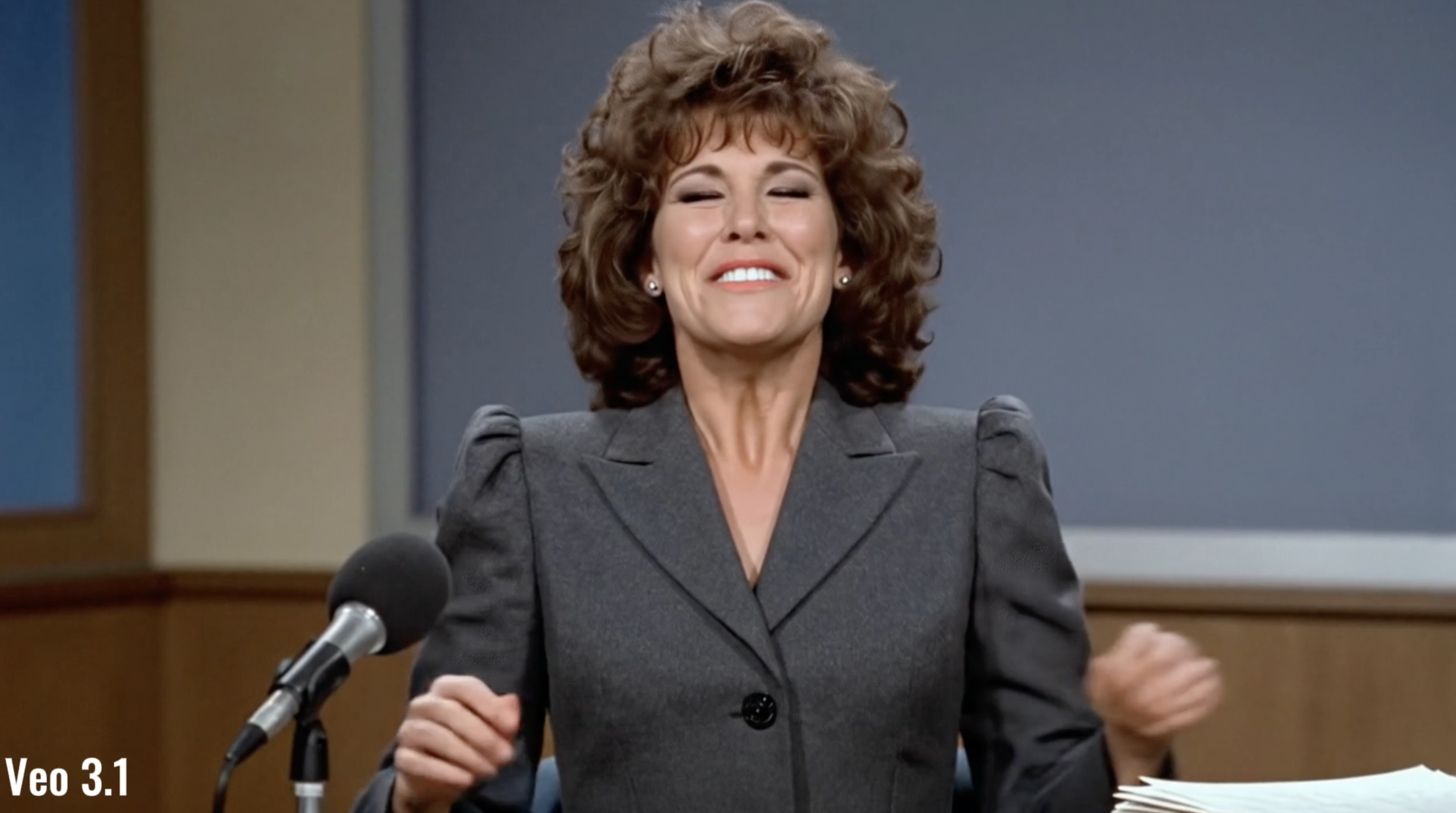
Since the arrival of Kling 2.6, a chorus has been going on repeat: “Kling buried Veo 3.1".
The formula is attractive. The reality, much less so.
At HEYIA Studio, we test these models on a daily basis on various productions, for our customers as well as for our training courses. And the results show a much more nuanced landscape than a technical knockout.
We compared the two models on five complex emotional scenes: laughter, nervous breakdowns, tears, deep tension, tight lip-sync. Contexts where models really come to light.
Here is a comprehensive analysis, enriched by feedback from creatives who use these tools every day.
1. Quality and stability: two models, two personalities
Kling 2.6 impresses with its moments of grace.
When he “just hits”, he produces expressions that are sometimes unsettling in realism. It is often the model that pushes facial micro-variations, fine emotions, and internal transitions the furthest. And on some specific animations (objects, stop motion, camera movements), it can outperform Veo.
But this performance comes at a price: irregularity.
Kling generates nuggets... surrounded by less convincing attempts, sometimes with artifacts or labial hallucinations. Achieving a usable scene requires more testing, time, and adjustments.
On the other hand, Veo 3.1 shines with its consistency.
Less spectacular at times, but reliable.
In our tests, Veo wins three out of five scenes, mainly thanks to his emotional stability, his more controlled acting and better overall coherence management.
This difference in philosophy creates a real creative dilemma:
- Kling for the quality “peaks”.
- Veo for consistency and predictability.
2. Lip-sync: a field that is still imperfect for everyone
Lip-sync is the subject where field feedback converges: neither model is perfectly usable without post-production.
- Kling sometimes seems to better manage facial micro-movements and lip sync when animating the same character on the same scene.
- Veo remains more stable, but can produce an acting that is too neutral if the prompt is not precise enough or too “wise”.
In any serious business workflow, the reality is simple:
using specialized tools (Weavy, ElevenLabs Voice Changer, etc.) remains essential for a consistent and clean voice.
The video template only does part of the job.
The end result depends on the complete pipeline.
3. Speed of iteration: the most underestimated variable
This is the dimension that the majority of “viral comparisons” forget, while it is the one that determines 80% of a studio's workflow.
- Veo 3.1 generates 4 variations in less than 1 minute.
- Kling 2.6 puts 2-4 minutes for a single video.
In production, this difference is not marginal.
Over a working day, it is transformed into dozens of additional versions, exploratory attempts, tested creative angles.
This is what makes it possible to iterate quickly, to validate an intention, to change an act or to correct an emotion without wasting half an hour.
On this field, Veo is still well ahead.
4. Cost and volume: a very concrete reality for studios
The calculation is simple:
- Google Pro (~€22) ≈ 100 8-second videos
- Kling (~€30) ≈ 30 10-second videos
In other words:
Veo allows three times more tests for an equivalent budget.
For a casual user, this may not be a topic.
For a creative team or a recurring production, this is a decisive factor.
5. What the creatives say: a match according to custom, not an absolute winner
The exchanges around this comparison show a clear trend:
• Specialized uses are redistributing the cards
For specific styles (illustrated stop motion, object animations, very artistic patterns), Kling can surpass Veo.
For constant emotional realism, Veo remains more reliable overall.
• The export format remains a liability for Veo
Its absence of HD or 2K limits some use cases.
If Veo 4 improves the resolutions, the balance of power could change abruptly.
• The quality of the prompt strongly influences the results
Feedback from the field shows that:
- Veo is better at accepting long or “French-style” prompts.
- Kling reacts better to writing that is more concise, more English, and sometimes subtler.
Therefore, the same prompt does not work the same way on both models.
• No model is ready for 100% native lip-sync
Professional workflows still systematically incorporate an external audio tool.
Our conclusion
This comparison shows it:
Kling 2.6 does not bury anything or anyone. And Veo 3.1 is not outdated.
Both models are powerful.
Both have blind spots.
The two are complementary depending on the style sought.
But for regular production — stability, speed, volume, costs — Veo 3.1 keeps a solid edge.
Kling 2.6, on the other hand, brings a touch of madness, surprising realism, and brilliance that raises an eyebrow.
It becomes a perfect tool as a complement, a “booster” for specific sequences or difficult emotions.
And one thing is certain:
The duel has only just begun.
Veo 4 is coming. Kling 3 too.
Gaps will continue to change, workflows will change, and the way we create will continue to change month after month.
At HEYIA Studio, we follow all this very closely to adapt our training, our productions and our methods.
As always: pragmatism, real tests, proven pipelines.

.png)

.webp)
