
.svg)


The context: a failed teaser for Demna at Gucci
It was to teaser the fashion show Primavera in Milan.
The first of Demna Gvasalia, formerly of Balenciaga, Vuitton and Margiela.
A name that weighs heavily. A huge expectation in the community.
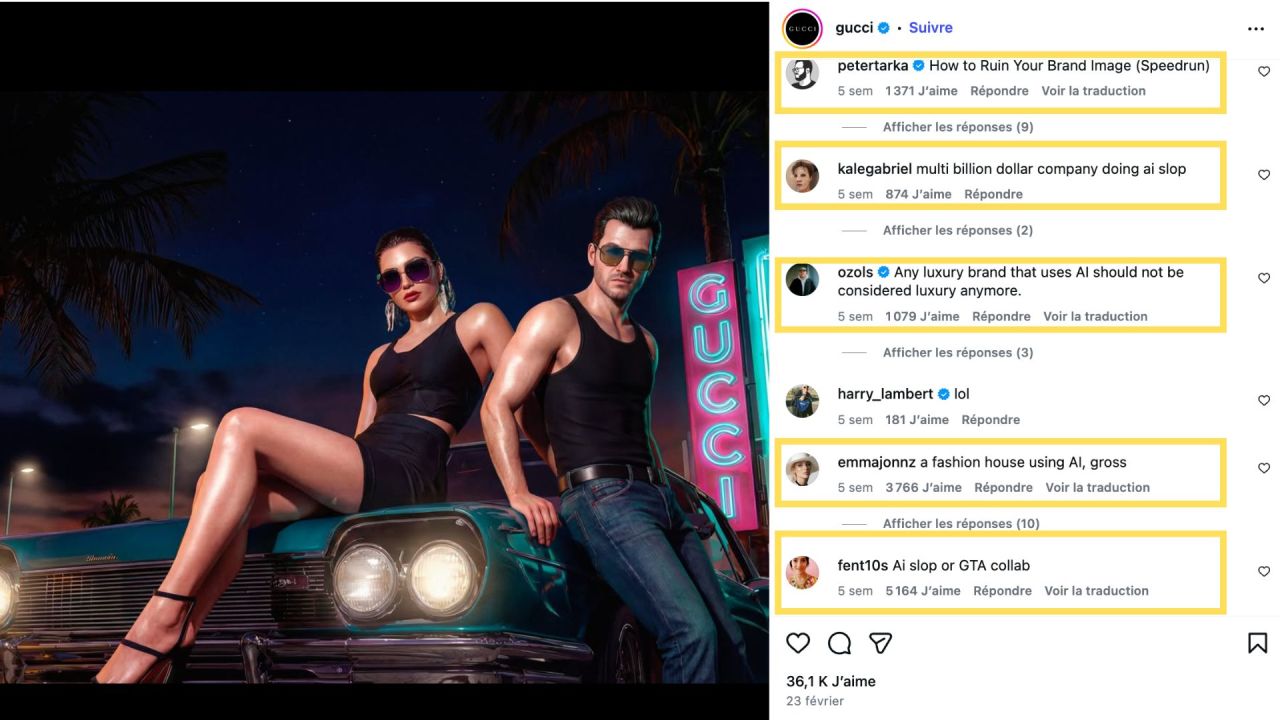
And this is what Gucci released:
— a woman in fur in a restaurant,
— a torque on a GTA-style muscle car,
— a Gucci satellite in space.
100% AI-generated visuals.
And obviously not hard enough.
The reactions: unanimous and violent
On Instagram, The reactions were not long in coming :
— “AI slop”
— “How to ruin your image”
— “Is that a joke?”
— “Gucci from Wish”
The community was very happy to go down the countryside.
And honestly, it's hard to prove them wrong.
These visuals look like Anyone can leave in 2 minutes on Midjourney A Sunday night watching a Netflix series.
The problem? We are talking about a house that sells bags for €10,000.
Thoughtful provocation or assumed sloppiness?
Some defend the brand.
They think Demna calculated everything.
The argument: it would be an ultra-thoughtful provocation, in line with what he did at Balenciaga. Playing on cheap, kitsch, and bad taste as an artistic approach.
Besides, interviewed by CNN backstage, Demna rolled her eyes: “I don't think it's controversial. In 2026, I'm using that as a tool. It's like in 2008 when brands refused e-commerce because it was not qualitative. I think that's ridiculous.”
Maybe.
But what I see is a message that is not getting through.
And when a message does not get through, even deliberately, it is rarely a strategic success.
The real problem is not AI
I want to be clear: I don't mind Gucci using AI.
Better still, I would have loved to see a great campaign.
A demonstration of what AI can produce when you put the resources into it.
The problem is the result.
When you are Gucci, with the budgets, the teams, the access to the best tools and creative AI in the world... how can you get that out?
It's not a technology problem.
It is a problem of requirement.
The signal sent to the ecosystem
Here's where it gets really problematic.
When a house of this stature leaves the AI slop, the signal sent is catastrophic.
For marketing teams who are fighting internally to get AI adopted.
Tomorrow morning in a meeting: “You see, even Gucci makes you ugly, we don't touch AI.”
For creatives who have been working for months to raise the level of quality.
They find themselves associated with AI slop because a giant botched the work.
For trainers (like us at HEYIA Studio) who spend their time explaining that AI requires method, time and expertise.
Gucci has just sabotaged all this intelligent evangelistic work into a campaign.
The real question: at what level of requirement?
The real question is not “Is luxury allowed to use AI?”
It is “at what level of requirement?”
Because if Gucci had released such a strong result that no one could find fault with it, we wouldn't have this debate.
The problem is never the tool. It is the standard that we impose on ourselves.
When you sell bags for €10,000, your visual standard must be irreproachable.
AI or not AI.
And that requires:
— creatives who really master the tools,
— iteration time,
— a real artistic brief,
— an assertive creative direction,
— tens (hundreds?) of tests before publishing.
No 3 prompts on Midjourney on a Friday night.
The Coca-Cola effect that repeats
This is not the first time that a major brand has taken a bad buzz for poorly controlled AI.
Coca-Cola had been demolished on Its AI Christmas ads.
InterMarché played the opposite card (“made without AI”) to surf the controversy with his wolf — a hundred artists mobilized for a year, more than 600 million views.
Each time, the same scenario:
1. Big brand releases botched AI content
2. Creative community is outraged
3. The camp of “AI is shit” Is getting stronger
4. The debate is becoming binary and sterile
And that's a shame. Because in reality, well-used AI is an extraordinary creative tool.
What to remember
This Gucci controversy is not an isolated case. It's a symptom.
Big brands want to use AI. Normal.
But they underestimate the expertise needed. Problem.
The result: botched campaigns that feed the camp of AI detractors.
But well-used AI can produce sublime results.
The lesson for any brand tempted by AI:
— AI is not a magic wand.
— Lower costs should never lower the level of requirement.
— A good tool + a bad brief = a bad result.
— A good tool + a good brief + a creative expert = sparks.
And if you're a house that costs €10,000 a bag, you're aiming for sparks.
Not on Sunday nights on Midjourney.
About HEYIA Studio
HEYIA Studio supports brands and agencies to integrate AI into their creation of visual and video content.
Our work is based on a simple triptych:
- an audit of uses and challenges,
- practical workshops oriented to production,
- and follow-up to structure clear, concrete and replicable workflows.
Learn more about our approach → here

.png)
.webp)
